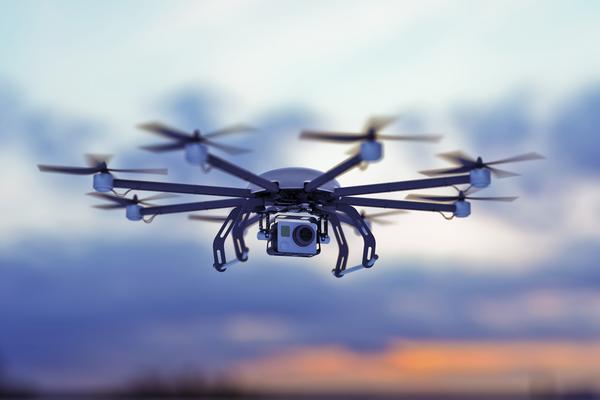

After decades, poaching still ravages Africa. So when journalist Ben Kreimer filmed a segment on the issue, he wanted a new way to tell the story. Rather than approach wildlife with a truck and a zoom lens, or film from high above with a helicopter, he flew a small drone. Mounted with a camera the craft hovered next to giraffes, elephants and rhinos. Now the viewer could look these threatened animals right in the eye.
The common associations with unmanned aerial vehicles (UAVs) or drones usually involve other things. The more than 3,200 related deaths in Pakistan. Destroying ISIS bases in Iraq. Blowing up Al Qaeda trucks in Yemen. And even in the United States, a too-easy way for the police to push the boundaries of privacy and spy on citizens without due process, as in California where Governor Jerry Brown just vetoed a law that would have instituted stricter requirements for a warrant when police use them for surveillance.
The industry selling consumer and commercial UAVs has put money toward swaying public opinion — tales of destruction don’t tell the whole story. When examining the future, there are applications for drones that many believe will bring real benefit to the workplace and humanity.
Matt Waite runs the Drone Journalism Lab at the University of Nebraska, where Kreimer was a student. He points out that a birds-eye view will provide important new perspectives for telling stories. (Maybe now you know what it’s like to be attacked by a hawk.)
Or take the heated and sometimes violent protests in Ferguson, Missouri. Police often barred journalists from certain areas due to “safety.” That prevented an impartial eye from covering how law enforcement interacted with citizens. A nearby drone with a camera operated by a media outlet would have provided the footage. Drones would also clear up smaller details, like the actual size of a crowd, a consistent point of contention between police, media and organizers.
Technologists like to say that robots do jobs that are “dumb, dirty or dangerous,” and when it comes to dangerous jobs, few environments are as harsh as the arctic. Researchers from the University of Colorado have been flying UAVs getting close to shearing glaciers and polar bears. In August, the Coast Guard began testing UAVs in the arctic to assist with search and rescue operations.
And drones might have other life-saving potential. A group in Germany is equipping them with defibrillators to zip out to people having heart attacks. Matternet, a highly touted drone maker in Palo Alto, California, has partnered with Doctors without Borders to fly medicine into remote regions of places like Papua New Guinea and Bhutan — where roads might be inaccessible — and carry out medical samples for laboratory testing.
Roof builders could pilot a drone to inspect a job before venturing onto a potentially unsafe surface. A construction crew building a new museum in Miami launched a drone that provided previously unattainable footage of their work. When The Open Standard chatted with Kreimer, he was on his way to New York to present a paper on computational models using data from drone footage to create digital 3D renderings, like an excavation site he’d recently visited in Turkey.
Makers with some technical chops are still unlocking the data drones can gather. Just recently, Kreimer built a custom mount for one of his drones that transmits footage wirelessly. “To do this work there’s a lot of hacking – building drones to do the proper job,” he says of why he got into the field. “This was an opportunity to take my love of making and modifying things, and apply it to something.”
Getting a handle on industry-wide UAV sales is tricky if not impossible at this point. “Nobody’s collecting that information yet,” says Melanie Hinton, spokesperson for Association for Unmanned Vehicle Systems International (AUVSI), the consortium representing UAV manufacturers. It’s still early, but there are clues that the consumer side is healthy. Amazon has a dedicated Drone Store and even hints that it will eventually deliver packages via UAVs.
But before Amazon or any commercial organization can take the skies, the government needs to set guidelines for commercial and research organizations. Right now it’s illegal without approval. Recreational crafts less than 55 pounds can operate below 400 feet of altitude and away from air traffic as long as the operator has a line of sight.
Where things get dicey is when people use UAVs for non-recreational purposes. Lawyers like Peter Sachs, who goes by The Drone Guy on Twitter, insist that there are no statutes or case law that give the FAA this power. Information requests of government documents indicate the same. Court cases like the one hobbyists, researchers and commercial organizations filed in August against the government might begin to clear this up. The FAA is supposed to have clearer rules some time in 2015.
For now, the FAA demands approval on anything remotely commercial and makes it clear that operation is not even allowed over your own property. The Electronic Frontier Foundation has fought legal battles with the FAA and finally got the agency to release the roster of domestic drone authorizations. “The only flying that is done in the US legally is through certificates of authorization” Hinton says.
This means many Americans with skills building and operating drones are bringing their skills elsewhere. “That’s why I’ve been working overseas,” Kreimer says.
In a 2013 economic report AUVSI said that along with public safety, agriculture would far and away reap the most economic benefit from opening up the skies to UAVs — both comprising “90 percent of known markets.” The applications would range from spraying crops, surveying water levels, measuring soil quality and finding missing livestock.
Drones outfitted with a robotic arm could fly out to the far ends of the fields and pick samples of fruits or pests to bring back for further tests, saving farmers a long walk or bumpy truck ride. Japan approved commercial drone flight two decades ago and the report notes that now 90 percent of aerial crop spraying is done by unmanned systems, saving money and keeping pilots away from chemicals.
Even Martha Stewart sings the praises of her drones for taking pictures of crops on her personal farm, which ostensibly makes it recreational and okay with the FAA, even though she posted them to her blog which is a marketing avenue for her commercial brand.
This isn’t to say that non-lethal drones won’t create problems of their own. The AUVSI study claims drone uptake will create over 100,000 jobs by 2025 in manufacturing and maintenance. Yet it does not tackle how many jobs drones will eliminate. Farms will need fewer hands for crops. Truck drivers and pilots may need to find other professions.
Even when drones aren’t armed with guns and missiles, they can also be dangerous. Hovering and filming over a tense crowd could exacerbate the situation — especially if each news outlet operates their own craft, resulting in a huge buzzing swarm of drones (the rotors make them obnoxiously loud). Even in Kreimer’s footage you can see that many of the animals are wary of this strange giant insect hovering near them. And if the winds whip or the power dies — most consumer drones have flight times less than twenty minutes — a big machine could land on someone’s head.
No one knows exactly what the future holds for UAVs. Even when the FAA does create new guidelines, new questions will continue to arise on a drone’s place in our world. Who knows how we’ll even operate them? A Texas research group showed they could control UAS flights with brain waves. Maybe mind-controlled drones are what delivers our tacos in the future.
From Open Standard