FAA to streamline drone permit process
The Federal Aviation Administration, the US agency that regulates the law of the skies, indicated this week that it is streamlining its process for approving the use of some small unmanned aerial vehicles in the domestic airspace for certain commercial activities like filmmaking, farming, and utilities inspection. While the FAA’s complete set of rules on domestic drone operation will not likely be finalized within the next calendar year—this despite the fact that Congress created a framework for the FAA to grant permits for small commercial drones in low-risk situations in 2012 with passage of the FAA Modernization and Reform Act—the agency has indicated that it will take steps to permit some small-scale commercial drones sooner than anticipated. “The FAA is proactively working to develop and disseminate information on the FAA’s authority… for people who want to operate [drones] for other than hobby or recreational purposes,” an FAA spokeswoman said.
Specifically, “The FAA expects to propose a rule allowing commercial drones weighing less than 55 pounds (25 kilograms) by November, according to a schedule of rulemaking efforts,” reports Bloomberg. Additionally, according to recent remarks given by FAA Manager of UAS Integration Jim Williams at the 2014 sUSB Expo, the FAA has already been fielding requests for specific small-scale commercial drone flights. In the speech, Williams explained: The FAA is working with ASTM International, a Globally recognized leader in the development and delivery of international voluntary consensus standards, to create standards for small unmanned aircraft. The initial release of these standards occurred earlier this year. The FAA is in the process of evaluating the standards with the objective of recognizing them for use in certification of small unmanned aircraft. We believe that aircraft manufactured, operated, and maintained according to consensus standards will lower the risk for people and property on the ground. The FAA’s change of heart comes in the wake of a ruling by an administrative judge with the National Transportation Safety Board (NTSB) in March, striking down a $10,000 fine against a man for unlicensed “commercial use” of a small drone airplane. While the FAA considers applications for “low-risk” drone uses in the domestic airspace, some drone enthusiasts are ignoring the FAA’s claimed authority altogether by carrying out commercial drone-for-hire businesses without a permit. One such company is the Los Angeles based “Drone Dudes,” which openly bills its technicians as “aerial cinematography specialists,” performing work-for-hire drone film production for Hollywood studios and other clients. “Whatever they’re doing is between themselves and their client, and it’s more of an underground operation now, I think,” Mark Bolonos of the Los Angeles Police Department, told National Public Radio. Nevertheless, Bolanos also explained of the filmmakers who use drones, “they want to comply with the law. I think most people want to do the right thing.”
$250K police drone crashes into Lake Conroe
Divers scoured the bottom of Lake Conroe in the hope of recovering a controversial $250,000 police drone that crashed into the water Friday. The Montgomery County Sheriff’s Office confirmed the remote-controlled helicopter drone, which was bought in 2011 with a federal grant, suffered a malfunction and went down during an exercise over the lake. The drone is equipped with a camera and an infrared scanning device and is used by MCSO for emergency management, missing-person recovery and operation overwatch, for example filming above SWAT team activities, spokesman Brady Fitzgerald said. “Divers did go down to look for it. They are still looking. It went down in deep water where there is a rocky bottom. Visibility is also a problem because of sediment at the bottom of the lake,” Fitzgerald said Monday. A further search Tuesday also failed to recover the drone with divers saying choppy water made things difficult. The mini helicopter, which weighs around 49 pounds, and, in a military setting, could be fitted with a single- or multiple-shot 40mm grenade launcher, 25mm grenade launcher or 12 gauge shotgun, according to Vanguard Defense Industries. Civil liberties organizations were critical when the ShadowHawk drone was purchased from Vanguard just over two years ago. At the time, Kirsten Bokenkamp, spokeswoman for the Houston-based American Civil Liberties Union of Texas, said the drones raise concerns because there are not enough safeguards in place to protect citizens from unreasonable search and seizure. “It’s just another example of technology that is outstripping our lives,” she said. “What we mean by that, is the technology moves so quickly and the interpretations of the Fourth Amendment are failing to keep up with the technology. That brings privacy concerns.” MCSO officials emphasize that the drone is not used for surveillance. Drones or unmanned aircraft are governed by the Federal Aviation Administration, which first authorized their use in the national airspace in 1990. Fitzgerald said deputies were confident the drone would be recovered and further investigation into the crash would follow adding that it was covered by insurance. “The drone is obviously a tool that we utilize and we would like to have it back,” Fitzgerald said.
Drones Are Now Delivering Champagne to Sausalito Hotel Rooms
For Sausalito tourists who have no interest in visiting the shoreline or Copita, there’s a novel new way to be entertained right from your hotel bed, and it’s way better than a minibar.
The Mansion at Casa Madrona, a Sausalito resort, has launched drone Champagne delivery for its fanciest guests. And we have to admit, it’s hard to beat sipping some high-tech Champagne while admiring the resort’s gorgeous views of the Richardson Bay and San Francisco skyine.
For now, the remote-controlled, octo-copter drone service – which is custom built to hold two Champagne bottles – is limited to the Alexandrite Suite (which you can book for $10,000-per-night), but the hotel is in the process of building more machines to deliver cookies and other treats so us plebians can experience the fun, too.
Woman claims she was sexually harassed by a DRONE after catching man flying remote-controlled plane at the beach that got uncomfortably close to female sunbathers
A beach-goer has complained she was sexually harassed by a pervert using a flying drone to spy on women. The unnamed woman claimed she was sunbathing on a private, residential beach in Virginia Beach, Virginia, when the incident happened. Posting on Reddit, she said: ‘We heard this whirring noise above us, and I looked up and saw a remote-controlled plane – one of the square ones that can move really articulately in all directions. No big deal. I turned back down and napped more.
‘Then I noticed: A. It was getting really close to women. Like, straight up in their asses close, flying really low, staying there for probably three minutes at a time; and B. It had a camera on it.’ Then she realized what was happening: The women at the beach were being spied on by a remote-controlled drone. In an email to the Daily Dot, she added that the 2ft by 2ft drone was making other women at the beach uncomfortable.She told how she walked up to the man operating the drone and said: ‘That is seriously creepy.’ He replied: ‘It isn’t going to hurt you.’ And then, getting angry she said: ‘I’m not worried about my PERSONAL SAFETY, though I am now worried a bit for YOURS. Your drone is creepy and violating. You need to take it out of the air, or I will.’ Eventually, the woman convinced the drone pilot to pack up his gear and leave the beach. After the incident, she claimed drone should be banned in public places. ‘Unless it’s there for recording a public event, there is no place for that sort of thing,’ she said. ‘At the least, it is a sound annoyance (the buzzing). At the worst, it is a personal violation.’
Please instruct the DOT and FAA to allow for the non-commercial use of UAVs in search and rescue operations.
The FAA currently has a policy which allows unmanned aerial vehicles to be used for recreational purposes only. They have prohibited organizations like Texas EquuSearch, a non-profit organization from utilizing these small unmanned surveillance aircraft which are vital to finding and perhaps saving the lives of lost persons. By prohibiting the use of these vehicles, the FAA may in fact be directly responsible for the loss of human life, which is a direct contradiction to its purpose. I urge the president and the administration to investigate the motives of the FAA and instruct them to change whatever polices that are in place and allow non-commercial search and rescue organizations to use these types of small aircraft.
Click here to sign
FAA, Drones Clash on Rules for Unmanned Aircraft
The near-collision between a drone and a commercial jet over Florida has added urgency to efforts by regulators to impose new rules on the proliferation of unmanned aircraft. Across the U.S., drones monitor crops, snap real-estate photographs, inspect roofs, shoot commercials and perform other tasks, according to people in the unmanned aircraft industry.
Pilots of those drones are defying seven-year-old restrictions on commercial unmanned aircraft by the Federal Aviation Administration, which has said the curbs are needed for public safety. But limited resources and legal complications have led to scattershot enforcement by the agency, emboldening even more drone operators.
The risks caused by the increase in unmanned flights were underscored by the agency’s revelation last week that a pilot of an American Airlines Group Inc. AAL -0.05% regional jet told officials in March that he nearly hit a drone about 2,300 feet above the ground while approaching a Tallahassee, Fla., airport.
The drone’s flying altitude was unusually high, since the FAA requires small types of unmanned aircraft to remain below 400 feet. Based on the description, the drone appeared to be a small model aircraft, but a senior FAA official warned that the drone could have done serious damage, such as if it were sucked into a jet engine.
Some proponents of unmanned aircraft worry that the near-collision could spark a public backlash and perhaps spur U.S. and state regulators to impose tougher restrictions than drone users claim are necessary. The FAA plans to propose in November, several years later than initially projected, new rules on how small drones could be used legally for commercial purposes. It could take several more years for the rules to become final. Jim Williams, head of the FAA’s unmanned-aircraft office, said last week that those rules will “ensure that risks are managed appropriately.” The issue “can’t get any more important to the FAA than it is today,” he said. “But unfortunately, the regulatory process is very slow and deliberative.” An FAA spokeswoman said that to protect “people in the air and on the ground,” introducing drones into U.S. airspace “must take place incrementally and with the interest of safety first.”
Matt Waite, a University of Nebraska-Lincoln professor who runs a drone-journalism program that got a cease-and-desist letter from the FAA last year, said he is concerned that the “longer it takes to have the rules of the road in place, the more the technology advances and the cheaper it gets, the closer we get to some knucklehead doing something dumb and hurting someone.” The FAA requires every non-recreational drone user in the U.S. to seek its approval. So far, the FAA has authorized only two commercial drones, both in Alaska.
Separately, the agency has fined two drone pilots, both for alleged reckless flying. In March, an administrative law judge overturned the first fine—a $10,000 penalty—ruling that the drone policy was a safety guideline and the agency had no legal authority to enforce it. The FAA is appealing. “Fewer and fewer people seem deterred by threats,” said one federal official. “Nobody is asking the FAA how to proceed, so it’s turned into a modern version of the Wild West, where some people think anything is OK.”
The agency estimates there could be as many as 7,500 drones in U.S. skies within five years of the new rules. People in the unmanned aircraft industry say that estimate is far too low. For example, Chris Anderson, chief executive of California drone maker 3D Robotics Inc. and the former editor of Wired magazine, sells about 2,000 autopilot systems a month to customers around the world who want to build their own drones. DJI Innovations, a Chinese maker of recreational and commercial drones, sells at least 10 times as many drones, Mr. Anderson estimates. DJI declined to provide figures but said its sales have at least tripled each year since 2009.
The FAA’s unmanned-aircraft office is run by several dozen people, whose tasks include drafting rules and vetting permits for public entities such as police departments to fly drones in designated airspace. Inspectors check into reports of reckless flying or commercial use.
Some drone operators aren’t shy about flouting the current rules. Mike Fortin, president of an Orlando, Fla., drone company that films concerts and TV commercials, received an email from an FAA official in January telling him that his business was violating FAA policy.
“My response to the FAA was to piss off,” he said. The FAA hasn’t followed up. If the agency sends a formal cease-and-desist letter, “I’d probably frame it, hang it up on the wall and keep going about my everyday business,” Mr. Fortin said. The FAA declined to comment on the incident.
In some cases, the FAA seems to be looking the other way. Mr. Williams, head of the FAA’s unmanned-aircraft office, said officials generally consider farmers who use drones to monitor crops as hobbyists. Hobbyists are traditionally allowed to use drones.
Companies might soon be allowed to apply for FAA certification for drones to be used in farming, filmmaking and inspections of power lines and certain parts of oil and gas plants, Mr. Williams said. Those uses aren’t allowed under the current restrictions.
Drone Dudes, of Los Angeles, has used drones for months to film commercials for companies such as Wal-Mart Stores Inc. WMT -0.01% and Kia Motor Corp. 000270.SE +0.53% “We haven’t heard a peep” from the FAA, said Eric Maloney, head of production at Drone Dudes.
Brian Emfinger, a photojournalist for TV station KATV in Little Rock, Ark., got a mixed response from the FAA after using a 2.2-pound drone last month to film the aftermath of tornadoes. The video has racked up about 2.4 million views on YouTube.
KATV news director Nick Genty said an FAA spokesman notified him that the station’s drone use was an FAA violation. Still, “they definitely didn’t tell us to stop,” Mr. Genty said, adding that KATV will continue to use drones for reporting.
The FAA said it regulates the use of drones, not how news organizations use footage
All New Parrot Bebop Drone!
Parrot Bebop Drone, the ultra-light drone with a full HD camera digitally stabilized on its 3-axis!
With Bebop Drone, Parrot demonstrates its technological expertise and confirms its commitment to the civil drone market. The Bebop Drone is a super-high-tech leisure quadricopter with features of a professional one!
Equipped with a 14 mega pixels fish-eye camera, the Parrot Bebop Drone takes video and pictures of the world in a 180° field with remarkable image quality. Endowed with a fully digital technology of image stabilization, the Bebop Drone captures video despite the movements inherent in aerial footage.
The combination of numerous sensors gives it impressive stability and great maneuverability when piloting with a smartphone or a tablet.
The use of the latest Wi-Fi 802.11ac MIMO and of four ceramic antennas 2.4GHz and 5GHz ensures an unequalled reach. For extreme sensations, the Parrot Bebop Drone can be piloted with an optional controller compatible with FPV glasses. Parrot extends its range of leisure drones with the Bebop Drone that takes professional-quality images.
FAA official: Drone, jetliner nearly collided over Florida
A Federal Aviation Administration official warned this week about the dangers of even small unmanned aircraft, pointing specifically to a recent close call involving a drone and a commercial airliner that could have had “catastrophic” results.
Jim Williams, the head of the FAA’s Unmanned Aircraft Systems (UAS) office, discussed various potential perils during a presentation Thursday to those attending the Small Unmanned Systems Business Expo. A video of his talk in San Francisco, and those of others, to those who operate, create or otherwise are involved or interested in such unmanned aircraft.
After saying “the FAA has got to be responsive to the entire industry,” Williams referred to a pair of incidents in which drones caused injuries to people on the ground. One came at an event at Virginia Motor Speedway in which an “unauthorized, unmanned aircraft” crashed into the stands, and in the other a female triathlete in Australia had to get stitches after being struck by a small drone.
Then, Williams segued to a pilot’s recent report of “a near midair collision” with a drone near the airport in Tallahassee, Florida. The pilot said that it appeared to be small, camouflaged, “remotely piloted” and about 2,300 feet up in the air at the time of the incident.
“The pilot said that the UAS was so close to his jet that he was sure he had collided with it,” Williams said. “Thankfully, inspection to the airliner after landing found no damage. But this may not always be the case.”According to the FAA, the incident took place on March 22 and involved as U.S. Airways Flight 4650 going from Charlotte, North Carolina, to Tallahassee.
The pilot claimed to pass “an unreported and apparently remotely controlled aircraft … five miles northeast of the Tallahassee airport, according to the federal agency. Such close calls are rare, the FAA notes.
The pilot reported that the small unmanned aircraft involved looked similar to an F-4 Phantom jet, and not like a helicopter that might hold a camera that many associate more closely with drones. Such planes have gas turbine engines and can fly higher than an average drone, according to the FAA. Neither the drone in this case, nor its pilot, have been identified “Imagine a metal and plastic object — especially with (a) big lithium battery — going into a high-speed engine,” he added. “The results could be catastrophic.”
All these incidents speak to “why it is incredibly important for detect-and-avoid standards (for small unmanned aircraft) to be developed and right-of-way rules to be obeyed,” Williams said. He added that such standards are in the works.
His agency reiterated this sentiment in its statement Friday.
“The FAA has the exclusive authority to regulate the airspace from the ground up, and a mandate to protect the safety of the American people in the air and on the ground,” the agency said. “…Our challenge is to integrate unmanned aircraft into the busiest, most complex airspace in the world.
Is this the future of safaris? Drones get up-close to capture spectacular footage of curious giraffes and a family of rhino
Forget blurry animal pictures and trying to pick out a far-off lion in the savannah, the new way to capture great safari pictures could be to use a drone. This spectacular close-up footage of curious giraffes, a family of rhinos and a herd of elephants was shot entirely using a drone, which hovered above the animals and captured them in their natural surroundings in Kenya. And with drones getting smaller and easier to transport, could this spell the end of disappointing safari photos featuring distant animals you can barely see?

As the drone films sweeping vistas and gets up-close with the animals, they can be seen looking up at the sky to see what it is, allowing the camera to capture amazing footage of their faces and how they interact with their families.
Mr Kreimer said ‘Footage like what we captured presents viewers with a captivating visual experience of the wild spaces and wildlife living in Kenya.

‘These landscapes and the animals living there are natural treasures, and unfortunately most people will not have the opportunity to experience them first hand. But with today’s drone technology we can provide a sort of armchair safari experience to anyone in the world with an internet connection.’
While the idea of creating safari footage for tourists appeals, one of the most important jobs a drone could do is help prevent poaching.
Mr Kreimer said: ‘In the context of wildlife and nature conservation there is great potential for drones as tools to prevent poaching. Conservationists in countries like Kenya can use drones to spot poachers before they kill animals. Ol Pejeta, the conservancy we flew at, has already tested drones in this context.’
The technology hasn’t just been tested on Kenya’s beautiful landscapes. Mr Kreimer has also filmed in India.
He said: ‘Before going to Kenya I was in India for almost six months, and while I was there I flew and filmed videos of beautiful and interesting places I visited.
The missile that never misses: Watch the incredible moment a drone launched ‘Brimstone’ hits a car moving at 70mph from seven MILES away!
It is the missile that never misses – and could be the future of combat. This incredible video shows the latest test firings of the aptly named Brimstone missile.Launched from a Reaper drone, it shows nine attempt to hit a car moving at 90mph – and nine direct hits. The tests, conducted at the US Naval Air Weapons Station in China Lake, California, in December last year show the Brimstone-equipped MQ-9 Reaper Remotely Piloted Aircraft (RPA) in action.
The missile scored nine direct hits against stationary and maneuvering targets traveling at speeds as fast as 70 MPH, while launching from up to 7 miles away at altitudes as high as 20,000 feet.
The tests were designed to show how Brimstone’s dual mode Semi-Active Laser and Active mmW radar seekers work in tandem to ensure direct hits, even against high speed and maneuvering targets.


Feds Confiscated a Hobbyist’s Drone Footage to Keep It Off the Internet
Yosemite National Park raised a few eyebrows this weekend when park officials suggested—using some pretty dubious legal framework—that flying hobby drones in the park is illegal. But the park isn’t the first to try to make up the rules as it goes along: Nearly three years ago, a famous drone pilot was illegally fined and had his property confiscated for flying a drone over the Grand Canyon, in what has become an important free speech issue.
The incident underscores a larger national problem being played out between entrepreneurs, model aircraft enthusiasts, and state, local, and federal governments. People like flying drones, for both leisurely and commercial purposes, and often the most interesting places to fly them are in big cities or pristine nature.
The Federal Aviation Administration isn’t keen to allow drone operators unfettered access to the skies, but doesn’t have the proper legislation or regulations to stop drones from flying under guidance similar to model aircraft. Instead, the FAA tried to finagle existing aircraft regulations to apply to drones, even when they clearly don’t.
It’s a situation where technology and the hobbies of the people have far outpaced government rules, and, rather than actually legislate or go through the proper channels and procedures to ban or limit drone use, authorities confiscate and fine first, then attempt to apply regulation later.
Long before Raphael Pirker became the first person to be fined by (and to subsequently beat) the FAA, he ran into trouble with rangers at Grand Canyon National Park. In December 2011, the Swiss drone pilot, one of the most well-known in the world, was taking footage of the Grand Canyon using a small, Styrofoam drone.
Park rangers approached him, demanded he ground the drone and that he delete any footage he took. Pirker turned over his drone’s memory card, but only after rangers threatened to obtain a search warrant to seize it, according to a citation report. Pirker was fined $325 and issued a ticket for violating a federal code that prohibits “delivery or retrieving a person or object by parachute, helicopter, or other airborne means, except in emergencies involving public safety or serious property loss, or pursuant to the terms and conditions of a permit.”
What’s happened to that footage, which Pirker planned to blast out to his tens of thousands of YouTube subscribers, is anyone’s guess. But it’s clear from the citation report that US government officials wanted it deleted to make sure it never hit the internet, where it would “invite additional individuals to replicate these prohibited flight maneuvers within Grand Canyon National Park,” according to the citation report.
In short, park management confiscated Pirker’s footage, not because it was explicitly illegal, but because authorities were concerned that sharing the footage would inspire more people to fly drones.
Drone crashes into Met Square building downtown
ST. LOUIS – Police are investigating after a drone crashed in downtown St. Louis Monday afternoon.
Schron Jackson, a spokesperson for the St. Louis Metropolitan Police Department, says Bike Unit officers responded to the Metropolitan Square building in the 200 block of North Broadway around 4 p.m. Monday after security officers called about a recovered article from a 30th floor balcony.
Jackson says the article is a DJI Phantom II Quadcopter, controlled through WiFi. It crashed into the building and landed on the balcony. Pieces of the drone were broken from the crash.
Police are now looking for the owner of the drone.
According to the FAA, civilians can have and operate drones, if you maintain a visual while flying and keep it under 400 feet above ground. The drone that crashed Monday hit the 30th floor of the 593-foot-tall building. It crashed into a floor that houses a law firm. Witnesses tell NewsChannel 5 an employee of the firm found the drone and called security.
Joshua Foster lives downtown St. Louis and doesn’t want to see a drone fly by his window that could potentially spy on him.
“It’s crazy that a drone actually hit this building and nobody knows where it came from?” he said. “That’s sickening.”
Drones are basically souped up remote controlled airplanes that can record video.
“We’ve got things flying around above us right here in Missouri in the middle of America,” said Foster.
St. Louis police now want to know who flew a drone. The mystery drone is controlled through WiFi connection and had a camera that rotates.
“What’s the point, it’s going back to privacy, and what’s the point of that, why would we need to fly drones,” said Carl Sword.
St. Louis Police Chief Sam Dotson sees great potential in drones for police work he talked to NewsChannel 5 last summer.
“To help keep officers safe, to help keep the community safe,” said the chief. “For monitoring public space, things like the upcoming Fair St. Louis, baseball games for terrorist, suspicious activity.”
He is trying to get waiver from the FAA to use one for the police department.
Just last year the FAA grounded drones used by journalism students at University of Missouri. They were using them for news coverage, but the FAA ordered Mizzou to stop flying and get government authorization.
Police would like to talk to the owner of the drone if you have any information call Crimestoppers: 866-371-TIPS.
Berkley, Ca fights to be Drone Free City
Berkeley— A battle over drones is taking place in the city of Berkeley. One side wants them overhead, the other side wants to declare the city a ‘no drone zone’.
The Disaster and Fire Safety Commission has recommended to allow police and fire departments to use drones for emergency situations. Those situations would require approval from the city manager, a police chief or the fire chief.
Lining up in opposition is the Peace & Justice Commission and the Police Review Commission. Both bodies are asking the city to ban drones altogether in the interest of public safety and privacy.
The Berkeley City Council will consider both sides in a work session on April 29.
There have been alleged sightings of drones by residents near the UC Berkeley campus and in North Berkeley but city officials denied ever using them.
Aerial specialist maps out benefits of drones:

THE managing director of an aerial photography and surveying business says the use of drones is of benefit to the community.
Chris Slee, who has recently set up ATEC-3D, says the use of light unmanned helicopters and fixed-wing aircraft helps shorten the time it takes to study and inspect vast amounts of land.
And although drone aircraft have been met with some bad press, especially those used in the military, the 29-year-old says unmanned aerial vehicles (UAVs) are safe to use in the right hands.
Mr Slee, who lives in Hythe, said: “My brother-in-law, Sean Spratley, is an environmental officer for a mining company, but surveying bits of land was taking days, so we thought there must be a quicker way of doing it.
“We found there were UAVs that you can use to survey a large area in a short space of time, as well as covering a much larger area. The obvious choice was to jump on board.”
Concerns have been raised about drones, with some academics stating they invade privacy, and noting several crashes.
But Mr Slee says his company’s official approval from the Civil Aviation Authority is testament to his crafts’ safety.
He said: “People seem to be anxious about them because of what they have read, but using UAVs commercially are safe, environmentally-friendly and saves lots of time.
“The safety aspect is something very important to us. It’s been a long time getting approval from the Civil Aviation Authority and various other things, but it is worth it.”
ATEC-3D mainly undertakes surveying work, for customers such as landowners and developers, but also offers aerial photography, including wedding coverage. Its craft include hexacopters, which have a 1.5-metre diameter, as well as fixed-wing aircraft from 200cm wide, with many supporting high-definition cameras.
Mr Slee, who was a detective for Kent Police before his career change, has recently been boosted by Kent County Council’s Expansion East Kent initiative.
He added: “We were fortunate enough to be successful for a £30,000 interest-free loan which has allowed us to buy a lot of equipment which we would not have necessarily been able to afford.
“I’m really enjoying it and it seems to be really moving in the right direction.”
As well as surveying, Mr Slee has also recently taken aerial photographs of Westenhanger Castle, Port Lympne wildlife park and floods in Yalding.
Video Released of the World’s Largest Multicopter:
- 05.08.14
EL SEGUNDO, California, 6 May 2014 – Advanced Tactics Inc. announced that it has received government approval for and has released the Black Knight Transformer first driving and flying test video. Advanced Tactics is at the forefront of large scale multicopter design, production, and testing and the successful flights of the Black Knight Transformer open the door to a number of future aircraft designs that leverage Advanced
Tactics’ patented and patent-pending technologies. The patented AT Transformer technology combines the capabilities of a helicopter, such as the ability to take off and land anywhere, with a modular payload system. The ground drive train can be detached from the flight system and replaced with an amphibious boat hull, cargo pod, or ISR pod.
The flight test was performed at a private location in Southern California and a remote backup pilot was present for safety. The stability and attitude of the aircraft was controlled entirely by the autopilot. The only commands from the remote backup pilot were to increase or decrease overall power. Outrigger landing gear was attached to the aircraft to prevent it from rolling over in case of any mishaps during testing. The aircraft completed multiple short hover flights. Although the aircraft is capable of hovering at thousands of feet above the ground, the altitude was limited to less than 10 feet above the ground for safety. The aircraft was stable, controllable, and performed as expected.

The AT Transformer technology is scalable and reconfigurable with modular payloads. Advanced Tactics is also currently developing an autonomous modular version of the AT Transformer capable of delivering up to 3,500 lb payloads in a detachable cargo pod at up to 200 kt TAS and capable of hovering for over 19 hours with a 150 lb ISR payload. Its small footprint makes it ideal for shipboard applications and tight landing zones. The AT Transformer technology can be interfaced with easy-to-use autonomous flight systems
that provide obstacle avoidance and decision making capabilities such as landing site selection. The aircraft provides a suitable platform for the recently demonstrated U.S. Office of Naval Research’s Autonomous Aerial Cargo/Utility System (AACUS) program and is already part of the U.S. Marine Corps Warfighting Laboratory’s Enhanced MAGTF Operations Aerial Delivery (EMO AD) program.
The Black Knight Transformer was proposed in 2010 to the DARPA Transformer (TX) program (renamed to DARPA ARES), but was not selected for the program. That program was originally intended to develop a flying truck but in 2012 the goals were refocused on cargo pod delivery. The Black Knight Transformer technology demonstrator has been developed with less than $2M in U.S. government funding and within the original DARPA TX timeline including the first flight in 2014. The AT Transformer technology can achieve and exceed all of the original and new goals of the program and can provide an affordable and better performing alternative to the aircraft being developed for DARPA ARES.
The Feds Accidentally Mailed Their Long-Range Drone to Some College Kid
- 05.08.14
A Redditor got more than he bargained for in the mail today: He was accidentally mailed parts to a $350,000 environment and wildlife monitoring drone owned by the National Ocean and Atmospheric Administration.
David Miller, a spokesperson for NOAA, told me he’s not sure how the wings and control panel to a NOAA Puma drone, which the agency uses to measure ocean debris, conduct seabird surveys, and monitor ocean habitats, ended up in the hands of the Redditor, but believes that UPS somehow erred and delivered it to the college student.
According to the Redditor (we’ve reached out to him to learn his name and hear more about his story), a college student who goes by the username Seventy_Seven, the drone arrived in a plain package delivered by UPS. The box was addressed to him and had apparently been sitting in storage for a while.
“Just called UPS. They told me that it was one of the undelivered packages in their office, and asked if I’ve ever had an undelivered package. I said no, but he insisted that it was mine, and said that it was up to me if I want to keep it or not,” he wrote. “Nothing on the outside of the crate said it was government property. I had ordered a weightlifting bench (which I received) and this came with it. Both boxes has UPS labels with my name and address. Though an odd box, I genuinely thought it was parts for the bench I ordered, since I wasn’t expecting a freaking drone.”
The package was mailed from MacDill Air Force Base in Tampa, Florida, where NOAA has an operations center. NOAA commonly uses drones (not the Puma) to monitor hurricanes and other weather off the Florida coast. A card in the package says “USA Federal Property Return to: NOAA Aircraft Operations Center.”
News media challenge ban on journalism drones – 05.07.14
WASHINGTON — More than a dozen media organizations challenged the government’s ban on the use of drones by journalists Tuesday, saying the Federal Aviation Administration’s position violates First Amendment protections for news gathering. The organizations, including The Associated Press, filed a brief with the National Transportation Safety Board in support of aerial photographer Raphael Pirker. Pirker was fined $10,000 by the FAA for flying a small drone near the University of Virginia to make a commercial video in October 2011. He appealed the fine to the safety board, which hears challenges to FAA decisions.
An administrative law judge ruled in March that the FAA can’t enforce its policy against all commercial use of drones when the agency hasn’t issued regulations for those uses. The FAA has appealed the judge’s decision to the full five-member safety board. Agency officials have said they hope to issue regulations for the use of small drones later this year. The FAA won’t currently issue drone permits to news organizations. Officials have sent warning letters to journalists found to have used small unmanned aircraft — most of them no bigger than a backpack — to take photos and videos. The agency suggested to one Ohio newspaper that it refrain from publishing video of a burning building taken independently by a drone hobbyist, even though hobbyists, unlike journalists, are permitted to fly drones, according to the brief.
“The FAA’s position is untenable as it rests on a fundamental misunderstanding about journalism. News gathering is not a ‘business purpose.’ It is a First Amendment right,” the brief said. The FAA said in a statement late Tuesday it was concerned that the NTSB judge’s decision “could impact the safe operation of the national airspace system and the safety of people and property on the ground.” Media organizations are intensely interested in using drones for photography and videos because they are far less expensive to buy and operate than a manned airplane or helicopter, and because their size and versatility provide visual perspectives often not possible with manned aircraft. Integrating unmanned aircraft into the national airspace also has the potential to improve the safety of reporting under less-than-ideal conditions, and unmanned aircraft by their nature pose less risk than helicopters, the news organizations said. Reports on traffic, hurricanes, wildfires, and crop yields could all be told more safely and cost-effectively with the use of unmanned aircraft, it said.
“This brief, filed by the country’s leading news organizations, supports the proposition we have argued that federal agencies must consult with the public before banning the use of new technologies that have many beneficial purposes,” said attorney Brendan Schulman, who is representing Pirker. “The argument becomes even stronger when First Amendment considerations are taken into account.”
Other media groups participating in the brief are Advance Publications Inc., Cox Media Group, Gannett Co., Gray Television Inc., Hearst Corporation, The McClatchy Company, the National Press Photographers Association, The National Press Club, The New York Times Company, the Reporters Committee for Freedom of the Press, the Radio-Television Digital News Association, Scripps Media Inc., Sinclair Broadcast Group Inc., the Tribune Company and The Washington Post.
Marathon Buzzed By Drones They Hired - 05.05.14
If you were at the Pittsburgh Marathon on Sunday and looked up, you might have noticed an object in the sky — an unmanned aircraft system buzzing around the site.But no, these are not some homeland security system or law enforcement tool.
“The Marathon came to us for a complete video production package to capture the whole event of the Marathon, the experience,” A.J. Brach told KDKA money editor Jon Delano on Monday. Brach is co-owner of a company called the Fresh Media Group, based in Washington, Pa. Fresh Media was hired by the Marathon, and part of that video package included aerial video, says co-owner Jennifer Trapuzzano.
“The Marathon was behind us every step of the way with the aerial,” adds Trapuzzano. “They were so excited to use the new technology and learn everything about it, too.” Fresh Media deployed three of these objects.If you saw this in the air, you might call it a drone, but these folks prefer to call it a multi-rotor copter. It’s pretty light, about 7 pounds, and it flies no more than 400 feet. It’s really a video platform for cameras, for cool shots of things below like the Pittsburgh Marathon.The raw video is pretty awesome.Flying at various levels — but no higher than 200 feet — the copters captured the incredible crowd of runners at the starting line and coming across the finish line.So how safe is this? Very safe, says Brach.
“For the marathon we went to those places a bunch of times, to make sure this is the safest place, no one’s going to be here, we’re off to this side,” he said. And the built-in GPS system guarantees it always returns to its point of take-off and no flights within 5 miles of an airport.
Chances are good we will see these again. “This is not the last, for sure,” says Trapuzzano.
Sussex Police say drones ‘could have helped’ in floods
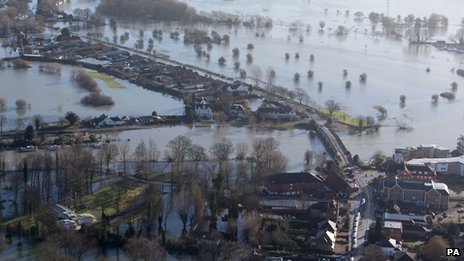 Supt Bracher said the force had seen media companies use drones to film flooding in Surrey
Drones could have helped police in their efforts to assist people affected by flooding, a senior officer has said.
Sussex Police is trialling a small radio-controlled device in rural areas near Gatwick Airport.
The pilot scheme, which is in its early stages, aims to test whether the force could cover wider areas using the same numbers of people.
Supt Brian Bracher said drones would have helped officers know “exactly what was happening” during flooding.
‘Up to speed’
He said the force had seen media companies use drones to film flooding in Surrey earlier this year, instead competing for and relying on “very expensive” helicopters.
“Had we had the ability of this device, it would have enabled our command to actually get a good view of exactly what was happening,” he said.
“We could have kept in one area if there was a particular concern.
“This is about us trying to get up to speed and use these systems in the same way that others are doing.”
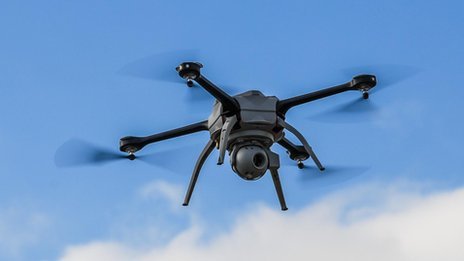 The aircraft beams pictures to police on patrol Landowners near Gatwick Airport were asked for permission for the aircraft to be deployed from their land. The three-month trial is being funded by the Association of Chief Police Officers (ACPO) to test how effective it could be in policing.It costs £35,000 for the equipment and £10,000 for the training of four officers to use it. If the trial is successful, the Aeryon Skyranger system could be used elsewhere in police operations, such as collecting evidence after collisions or major incidents and in the search for wanted or missing people.
New 360 degree camera, could be great on Drones
It’s small but powerful. Sleek yet tough. And you’ll never think of video the same.
CENTR is the first 4K resolution panoramic camera that allows you to capture your whole experience. Red Bull, FOX Sports, National Geographic, and the US Army are already using it.
We’ve tested our cameras all over the world and beyond – from African safaris to the edge of space. Now, we’re bringing CENTR cameras to you.
What does CENTR do?
- CENTR creates 360° 4K footage in real time.
- CENTR is splash-proof.
- CENTR has a quick-release battery which easily locks into place when you’re on an adventure.
- CENTR enables individual camera selection, so you don’t have to shoot in 360° all the time.
- CENTR footage can be viewed through your desktop, smartphone, or tablet in real-time through the CENTR interactive player.
- You can create everything from panoramic time lapses to the ultimate 360° selfie.See more at this link