
Drones will be used in warehouses everywhere
Drones seem to be everywhere at the moment, from doing military duty in the skies to bouncing around the local toy store. One place we haven’t seen them is in warehouses. Airborne drones probably won ’ t have the capability to pick and place, however t here are some repetitive warehouse operat ions that are well suited to a robotic device. Physical inventory, stock counting and cycle counting could all be done by a drone , and soon will be. What can we expect from the drones and how could we prepare for them? Is your warehouse drone ready? Why drones ? When it comes to repetitive barcode scanning operations out of reach of a human, drones can be 100 times faster and 100 times more energy efficient than using a reach truck to lift a 0.8 kg barcode scanner held by an 80kg human in a 100kg man – cage up to each item to scan it. A n 800g drone can lift an 80g barcode scanner to do the same thing. A drone operator can count as much stock in a warehouse in two days as a team of 80 people with handheld scanners and reach trucks can count in 3 days. The time and labour saving benefits are especially evident in stock counting of large, uniform warehouses containing tens of thousands of handling units above head height. There are also energy savings to be made since reach trucks don’t need to be used for barcode scanning . There are inherent safety risks in lifting a human up to high racking to scan barcodes, in this regard the drone is far safer
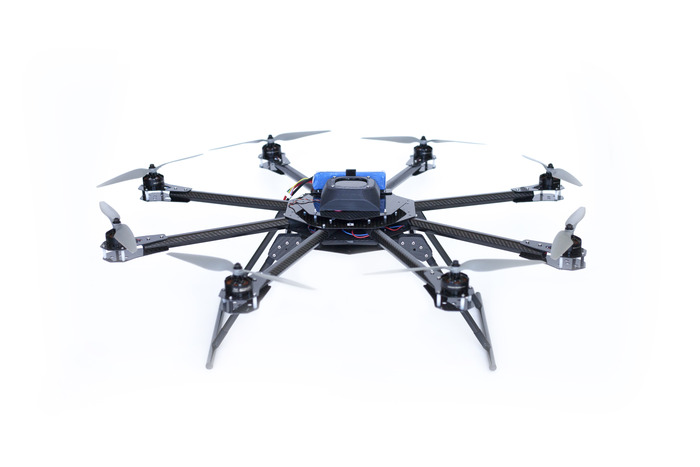
Drones are a stable, lightweight, maneuverable , battery powered flying platform . They can have multiple propellers ( e.g. multi – rotors, quad copter s, tri copter or hexa copters ) or a single propeller ( e.g. a helicopter ) . They are capable of carrying a small payload proportional to their size. In the last few years, microchip gyros have meant that a tiny on – board computer ca n keep the UAV stable in the air . Recent adv ances in sensor and image processing technology coupled with m any hours of software development have meant that they are now capable of robotic type motion. There are many videos of drones performing h ighly precise robotic movements indoors, however these drones rely on a navigation system made up of many cameras mounted in fixed positions a few feet apart. This is cost prohibitive to set up in a warehouse. Outdoors , drones can do amazing things like del ivering your theoretical parcel right to your front garden . This is because they have access to GPS which an absolute positioning system of 1m Accuracy. If the dr one delivering your parcel is a few feet left or right of the landing z one , you wouldn’t really notice. However if a drone was inspecting stock in your warehouse and it got out of position by a foot it would likely crash into the racking. Indoors, drones don’t have reliable access to GPS, an d even if they did, the space in a warehouse is limited , and the navigational accuracy needs to be down to a few inches not a few m etres. Th ese challenges are the main reason that we haven’t seen drones in our warehouses. Yet ! Drones are be ing designed and built specifically for warehouse use. They are being integrated directly into WMS syste ms and will work with little operator input . Drone stock counting services will be on – call . T hey will come in with their equipment on a weekend, download your wa rehouse layout, scan all the item s in your warehouse and give you a report on the Monday morning for doing your stock adjustments. New job descriptions will appear like “ drone operator ” , “ drone service technician ” and “ drone integrator ” . Drones will eventually do other tasks like continuous inventory, searching for items, and once found, hover there or mark them with an inking device .
It took a computer programmer with warehouse experience and a drone building hobby to realize that warehouses have an intrinsic absolute navigation system , both in horizontal movement and vertical movement : warehouse racks are uniformly spaced and laid out for horizontal positioning in one dimension , every bin location is labeled with a barcode for horizontal positioning in another direction, every shelf is at a known height for vertical position information . In palletized warehouse s , the items on the shelves have barcodes in consistent places providing a fixed area in which to find the item barcode . This means that no additional infrastructure is needed to provide an absolute positioning system for the drone to navigate along . An application for a patent using this navigational method was made under: Patent Application:PCT/ZA2014/000029 AIRBORNE SCANNING SYSTEM AND METHOD A scanning system has been developed that makes use of a database of bin locations to determine the drone ’ s absolute position from scanned data and figure out , in real – time what the drone must do next. The scanning system has been designed to integrat e into both vision process ing systems and simple on – board sensor systems . N one of these navigation systems rely on fixed infrastructure e.g. beacons , fixed cameras or indoor GPS system s, they rely on the drone being aware of , and responsible for avoiding, its immediate surroundings and a database to provide contextual information to direct it into performing its robotic tasks. The scanning solution is designed as “ BYOD ” – bring your own drone , not locked into any one drone or navigation plat form nor into any one ERP or WMS. This makes it flexible for adaptation to new drone and navigation technologies as they become available
Other Posts you might like about Drones
 Drones may replace librarians soon in New York City
 Drones to monitor Abu Dhabi
 Reports of drones flying near U.S Airports
 That Drone Show Daily: Drones to the Rescue